Home What Is a VIN?
VIN Guide

What Is a VIN?

A Vehicle Identification Number (VIN) is a unique 17-character code assigned to every motor vehicle at the time of manufacture. No two vehicles in operation share the same VIN, which is why it is often described as the closest thing a vehicle has to a fingerprint. To understand why that matters, this guide explains what a VIN means, how to read it, where it is used, and why it matters when buying or selling a vehicle.

What is a VIN

17

Characters long

1981

Standardized globally

0, I, Q

Never used (avoid confusion)

Unique

Per vehicle, worldwide

“A VIN is the vehicle’s permanent ID number. It helps identify the exact car, including details like the make, model, year, engine, body type, and where it was made. But the VIN alone does not show the full history. It will not tell you how the vehicle was used, maintained, damaged, repaired, or sold.”

Martynas Baniulis

Chief Editor

The basics

Every car, truck, motorcycle, bus, and trailer built for road use has a VIN. It is stamped or attached to the vehicle in multiple locations and recorded in title documents, registration papers, and insurance policies.

The VIN standard (ISO 3779) was adopted globally in 1981. Before that, manufacturers used their own systems, which is why pre-1981 vehicles have inconsistent identification formats.

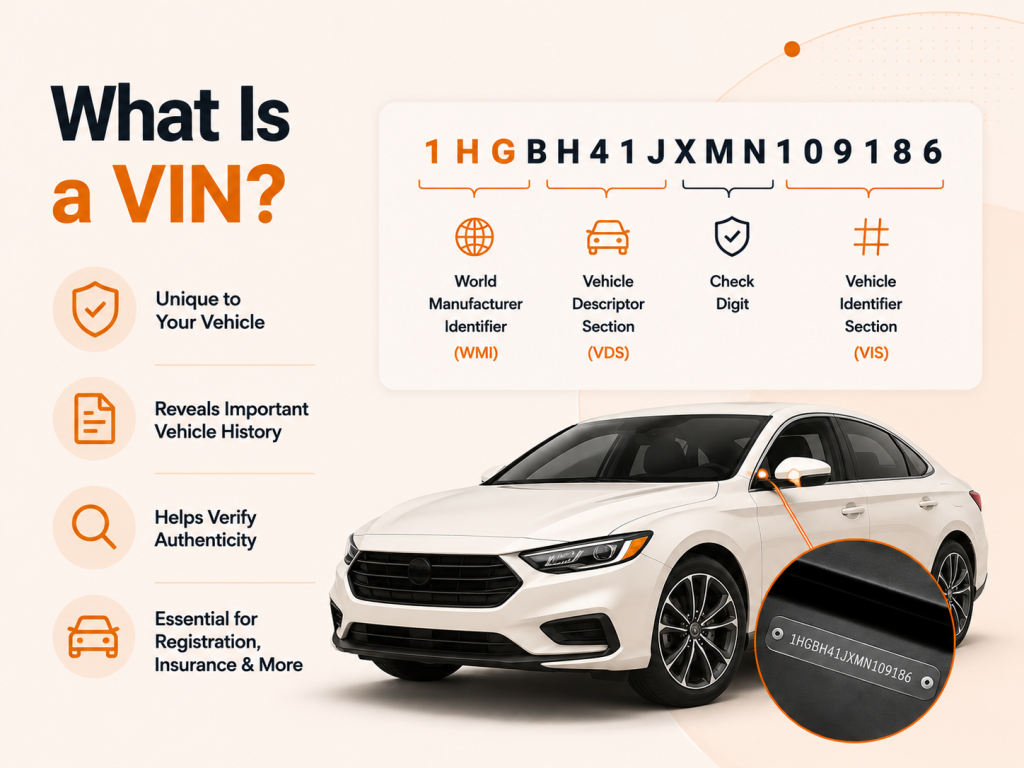
The 17 characters are not random. Each position carries specific meaning – manufacturer, vehicle type, model year, factory, and production sequence. Together they describe exactly what the vehicle is and where it came from.

Three characters – 0 (zero), I, and Q – are never used in a VIN because they can be confused with 0 (zero), 1 (one), and 9 in certain fonts and handwriting.

EXAMPLE VIN
1
H
G
B
H
4
1
J
X
M
N
1
0
9
1
8
6
Positions 1–3: World Manufacturer ID
Positions 4–8: Vehicle Descriptor
Position 9: Check Digit
Position 10: Model Year
Position 11: Plant Code
Positions 12–17: Sequence Number

What each position means

The 17 characters are divided into three sections, each encoding different information about the vehicle.

World Manufacturer Identifier

Identifies the country of manufacture and the manufacturer. For example, "1HG" means Honda made in the United States.

Vehicle Descriptor Section

Encodes the vehicle type, model, body style, engine type, and restraint systems. These five characters describe what the car is.

Check Digit

A single character calculated from the other VIN digits. Used to verify the VIN is mathematically valid and not fabricated.

Model Year

A letter or number that indicates the model year. "K" = 2019, "L" = 2020, "M" = 2021, "N" = 2022, "P" = 2023, "R" = 2024.

Plant Code

Identifies the specific assembly plant where the vehicle was built. Each manufacturer uses their own plant codes.

Production Sequence Number

A unique serial number assigned in order of production. No two vehicles from the same plant in the same year share this sequence.

Real VIN Example

1HGBH41JXMN109186
This seemingly random sequence actually contains precise information about the manufacturer, vehicle specifications, model year, assembly plant, and unique serial number.

What a VIN tells you about the vehicle

When you decode a VIN, you can confirm the following factory specifications – directly from the manufacturer’s encoding.

Make, model, and trim

The VIN encodes the manufacturer, vehicle line, body style, and series - so you can confirm what the vehicle actually is versus what it is listed as.

Engine and drivetrain

Engine type, displacement, and transmission configuration are encoded. Useful when a seller claims an upgrade that is not factory-installed.

Country and plant of manufacture

The first character tells you the country, and position 11 tells you the factory. Both matter for parts compatibility and recall tracking.

Model year

Position 10 encodes the model year. This is especially important for vehicles sold near year-end when the model year differs from the calendar year.

Important to know

What a VIN does not tell you

A VIN is a manufacturing identifier, not a history report. The characters encode what the vehicle was built as – not what happened to it afterward.

For buyers, this is the critical gap. The VIN confirms what the vehicle is. It does not tell you what condition it is in, who owned it, or what they did with it.

That is where community-shared knowledge becomes useful. A previous owner, buyer, mechanic, or someone who already researched the vehicle may have notes, photos, receipts, old listings, or report findings tied to the same VIN. These details can show what the VIN itself cannot – how the vehicle was used, maintained, repaired, listed, or sold after it left the factory.

Not encoded in the VIN

Common confusion

VIN Decoding and Vehicle History Reports Are Not the Same

This is one of the most common mix-ups for used car buyers. A VIN can help you look up a vehicle, but the VIN itself does not contain the vehicle’s full history.

A VIN is a permanent identifier assigned at the factory. Decoding it tells you what the vehicle was built as: make, model, year, body type, engine, trim, plant, and other manufacturing details.

A vehicle history report is different. It tries to show what happened to that vehicle after it was built. These reports use the VIN as the lookup key and pull records from outside sources, such as title databases, insurance records, auctions, odometer records, theft databases, service records, and other reported events when available.

VIN Decoding

Reads the factory information built into the VIN. It can show:
This data is useful, but it is limited. It tells you what the vehicle is, not what happened to it.

Vehicle History Reports

Checks records tied to that VIN over time. Depending on the provider and available data, it may show:
This information is not stored inside the VIN. It comes from outside databases and reported events.

Why People Confuse Them

People confuse VIN decoding and vehicle history reports because both start with the same thing: the VIN. But the VIN is only the key.

Decoding the VIN tells you the vehicle’s factory identity. Running a vehicle history report uses that VIN to search for outside records connected to the vehicle.

That is why two VIN tools can show very different results. One may only decode the vehicle. Another may check public data. A paid report may search title, insurance, auction, odometer, or other private records. Community posts can add another layer by showing what other people found or experienced with that exact VIN.

The best way to think about it is simple:

A VIN decoder tells you what the vehicle was built as.
A vehicle history report tries to show what happened to it later.

Comparing vehicle history report providers?

See our breakdown of the best vehicle history report companies - what each one covers, what it misses, and which is worth paying for.

Why the VIN matters when buying a used vehicle

Verify the vehicle is what the seller claims

Sellers sometimes misrepresent the model, trim, or engine. Running a VIN check against official records lets you confirm factory specs before you commit to a purchase.

Check for recalls

Open safety recalls are tracked by VIN. If there is an unaddressed recall on the vehicle, you should know before buying - not after.

Spot title and theft issues

Basic VIN decoding alone cannot reveal title brands or theft records - that requires a vehicle history report, which aggregates data from DMVs, insurance companies, and law enforcement using the VIN as the lookup key. Title brands like salvage, flood, rebuilt, or lemon law buyback are only surfaced through that report, not from the VIN itself.


Access community knowledge tied to the VIN

On Easy VIN Check, community members can attach notes, photos, old listings, and findings directly to a VIN. That information travels with the vehicle across every future sale.

Always verify the VIN physically

Before trusting any VIN-based record, confirm the VIN on the vehicle matches the VIN in the title and registration. A mismatch is a serious red flag. The most common location is the dashboard on the driver's side, visible through the windshield. Also check the door jamb sticker and the engine block. On stolen vehicles or those with cloned identities, these numbers sometimes differ.

Ready to check a VIN?

Run a free VIN lookup and see public data plus everything the community has shared about that specific vehicle. No account required.